Recently in Constitutional Law Category

Federal Prosecutors Withhold Exculpatory Evidence

March 29, 2012

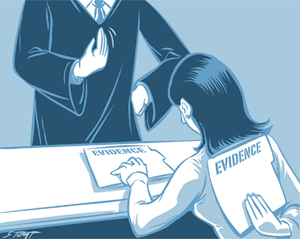
Alaska Senator Ted Stevens was prosecuted for corruption in office by the United States Attorney's Office. He allegedly failed to disclose gifts made to him. He was found guilty following a jury trial. The jury based their decision on what was provided to Stevens' defense team. However, what Stevens and the jury didn't know was that important statements of witnesses and testimony which was exculpatory (tending to show Stevens' wasn't guilty) was not given to the defense.

The lawyers from the US Attorney's Office knew that their most important witness was having sex with underage girls and part of this witness' testimony against Stevens was most probably fabricated. Not only did the prosecutors know about these issues with their key witness, which could be used to impeach his credibility, but they covered it up. Not only didn't they turn the information over to the defense, they hid it from Stevens' defense team. Apparently, the prosecutors' desire to obtain a conviction overcame their sense of right and wrong, justice, and ethical duties.

Why is this important? First of all, the defendant's right to a fair trial hinges on the prosecutor being fair and open with all evidence which could be termed exculpatory. Anything that reflects on the credibility of key witnesses must be turned over to the defense. Failure to do so cheats the system, the defendant in question, and undermines everyone's faith in the criminal justice system.

In this case, Senator Stevens was unable to continue as a US Senator. The citizens of Alaska were deprived of their elected representative. In the end, if the prosecution, who controls the flow of information and conduct of law enforcement, can't be trusted to respect justice then every prosecution of every defendant is called into question.

Respect for the law is necessary for the citizens of our country. If you don't believe you will be treated fairly in the judicial system, society can descend into anarchy. People will take the law into their own hands. Corruption of the judicial system leads to abuse and the trampling of citizens' rights. If you can't trust the prosecutor to be honest and to turn over evidence which could lead to exoneration faith is lost that there is any justice.

The criminal defense attorney can require the court to order the prosecutor to turn over exculpatory evidence. But, if the prosecutor seeks to subvert justice then each and every one of them should pay the price and find themselves in the defendant's seat at the table of justice.

The Supreme Court and Eyewitness Testimony

February 9, 2012

The United States Supreme Court on January 11, 2012, rendered a decision in Perry v. New Hampshire, that limits the ability of the defense to successfully attack a suggestive or unreliable identification of the defendant by an eyewitness. Eyewitness identification has long been the subject of commentary and even experiments. Many of us have seen the video of or even participated in a situation where a professor has a classroom full of students when a subject rushes in steals the professor's purse and the class is asked to describe the suspect. It's incredible how varied the descriptions of the suspect are. Different facial features, races, clothing, height and weight and numerous other identifiers have been listed by witnesses seeing the same thing. How many times have you been in line at a theater, seen someone you think you recognize and been mistaken? It's happened to all of us.

Stress of an unexpected, even scary, situation can affect one's perception and ability to accurately identify suspects or describe events. On a personal note, I witnessed a car crash right in front of my eyes. I stopped, waited for the police, submitted to an interview, and was told that my account was completely "wrong". Physical evidence and other eyewitnesses made it quite obvious that what I thought I had seen was just plain in error. I didn't mean to mess it up or make a mistake, it just happens because when events occur quickly under unexpected conditions what we think we see isn't always what actually happened.

Now, when a police officer investigates a crime and gets a description of the suspect from the victim he can just take the information or by his questions and technique he can influence the identification. For example, when a photograph of a suspect is shown to a victim several similar looking photos are used in a "six pack". The eyewitness is asked to view the subjects, admonished it's just as important to exonerate the innocent as to find the guilty person and just because a picture is in the "six pack" it doesn't mean the perpetrator's photo is contained in it. When that doesn't happen and a singular photo is shown to a witness and no positive identification is made, what do you expect would happen if that same singular photo is placed in a subsequent "six pack" ? Isn't that overly suggestive? Isn't that type of police technique almost ensuring the identification of the photo of the singular photo individual? Of course it is. Once suggestive procedures like this one are used, the ultimate identification of the suspect (now defendant) taints the whole process. Now you will never know if the identification is the product of what the eyewitness saw or the suggestive procedure used by the police.

In spite of the above, the Supreme Court has decided in Perry v. New Hampshire that the "reliability of relevant testimony typically falls within the province of the jury to determine". In plain terms, unfairness, unreliability, and suggestiveness as well as due process challenges to the identification procedure are now points to be argued to the jury. Don't look to the judge for help. Look to the best criminal defense trial lawyer you can find because that is where the case and the identification will be decided.

Recent Supreme Court Case Requiring Search Warrant for GPS Device

January 24, 2012

On January 23, 2012, the United States Supreme Court issued it's decision in United States v. Jones. The Jones decision is noteworthy because it requires law enforcement to obtain a warrant when using a GPS device. A look at the facts in Jones is necessary to understand the Court's reasoning.

The Government obtained a search warrant which allowed it to install a GPS tracking device on a car registered to Jones' wife. The warrant authorized the GPS to be installed within 10 days of the issuance of the search warrant. The agents waited until the 11th day to install the device (after the expiration of the warrant). Then the Government tracked the vehicle's movements for 28 days.

As a result of the tracking of the vehicle an indictment was issued charging Jones with drug trafficking and conspiracy. The trial court issued a split decision when Jones moved to suppress the evidence obtained by use of the GPS device, stating when the vehicle was parked at Jones' house it was an illegal search but when it was on the public streets there wasn't any expectation of privacy and therefore no illegal search. Jones was convicted and appealed.

At oral argument the Supreme Court members voiced concern that even they could be placed under surveillance at the whim of the Government without the benefit of a search warrant. In other words, the buffer between an invasion of privacy by the Government was becoming so intrusive without a court officer's watchful eye anyone's privacy could be invaded at any time. In its decision the Court held the Fourth Amendment to the United States Constitution protects "persons, houses, papers, and effects, against unreasonable searches and seizures". The Governments' physical intrusion on an "effect" (car) for the purpose of obtaining information equals a search within the meaning of the Fourth Amendment. The Court did not address the Government's contention that Jones did not have a "reasonable expectation of privacy" because the Court focused on the Government trespass on the area where the GPS device was placed.

Significantly, the Court did not overrule the recent line of cases which sanctioned monitoring by other forms of electronic devices such as beepers without a search warrant. In addition, while the decision was unanimous not all the justices joined in the rationale for the decision. In essence, the Supreme Court didn't want to allow such GPS devices to be placed on vehicles without a search warrant but had varied reasons why it was a violation of the Fourth Amendment. Because of this lack of unanimity of reason, the decision may not have the far reaching effect that some think it does.

A WASTE OF THE COURT'S TIME AND MONEY IN LOS ANGELES, CA

January 4, 2012

How many criminal cases are in the courthouse that don't belong there? Plenty, that's clear from a recent case in the Los Angeles County Court. A homeowner gets cited for his dog running loose. The citation is for a misdemeanor because the County Ordinance carries the possibility of six months in jail for each violation. If a criminal defendant is subject to a jail sentence then certain rights apply.

The United States Constitution guarantees due process, right to a jury trial, confrontation of one's accuser by the defendant, and the right to remain silent, among other rights. All these rights apply in California when a defendant is facing jail time for a violation of law.

But, surely, the dog owner isn't facing real jail time for letting his dog run loose....is he? If the law that is violated is a misdemeanor, then all the above rights apply no matter how absurd the possibility of jail time is. Therefore, if the dog owner wants a Public Defender, at tax payer expense, and he is indigent, he is going to get the Public Defender. The Public Defender is an attorney, with clerical staff, office costs, investigators, and with an overwhelming case load of needy clients. Yet, no matter, the dog owner gets a lawyer at government expense.

Or if the dog owner is a responsible, non-indigent taxpayer, then he has to pay for his own lawyer, his own investigator, and his own expenses. But, surely common sense will prevail and the judge will see that his calendar is full of cases that really demand his time and energy to a larger extent than this dog running loose case. Not so. The system marches on. It doesn't look right or left just keeps plowing forward wasting thousands of dollars prosecuting the miscreant dog owner. The prosecutor, yes, there is a real Deputy District Attorney who is prosecuting this case, doesn't see what a waste of precious resources this is. Neither the judge nor the prosecutor reduce this case to an infraction thereby eliminating the possible jury trial, appointment of the Public Defender, and the waste of countless thousands of dollars. Much like the dog, this case is running wild with taxpayer money. And the court system says it's running low on funds and needs more money fed into it from the precious few taxpayer dollars available. Is anyone listening? Common sense is screaming but apparently only a few of us care.

Orange County, CA Murder Charges Blocked From 1997

September 2, 2011

Before 1997 if someone was injured by a defendant during the commission of a crime and died more than three years and a day after the crime, he could not be convicted of murder. Recently, a case came before the Court of Appeal that tested this assumption.

Two defendants, Robert Duston Strong and David Michael Knick were charged with murder because they shot a sheriff's deputy more than 30 years before and he recently died of complications from his injuries. Meanwhile, the defendants had served time in prison for their crimes and completed their sentences for the crimes they were charged with at the time.

The legal question became: could the defendants now be charged with murder because the sheriff's deputy finally succumbed to his injuries many years after the original crime?

The Court of Appeal issued a ruling that the law that was in effect in 1997 controls the issue. The defendants could not , in 2011, be charged and convicted of this greater crime, murder, even though the cause of death was undeniably the injuries caused by these defendants.

There isn't a statute of limitations on murder so why not now charge them with murder? The answer is found in the fact that back in 1997, the law provided that in order to have a murder, the death had to occur within the time period of three years and one day. If the death did not occur within that time then it simply isn't murder per the statute. To hold otherwise violates the Ex Post Facto provisions of the United States Constitution. Essentially, the law says you can't increase the punishment for a crime after it is committed and then punish the defendant with the greater punishment no matter how awful the original crime was.

The rule of law is basically that whatever the law is at the time the crime is committed, that is what controls whether or not the defendant can be charged and/or punished for the acts committed at that time.

In Orange County, CA, Race Matters In Picking A Jury, Part Two

August 18, 2011

"A party may not use a peremptory challenge to remove a prospective juror on the basis of an assumption that the prospective juror is biased merely because of his or her race, color, religion, sex, national origin, sexual orientation, or similar grounds." Code of Civil Procedure Section 231.5.

If a party (represented by his or her lawyer) uses a peremptory challenge in an effort to systematically exclude a member of a recognizable group, it is error under both the California State Constitution and the United States Constitution. But, as a trial lawyer, I thought for years that I just wanted fair, impartial, open minded jurors. I thought race didn't matter if someone was "fair". I was wrong. Race matters even more than the strength of the evidence or the law given to the jury by the judge.

To date, I have tried well over one hundred and seventy five jury trials. These trials have been for almost every conceivable charge, from assault and battery, to shop lifting, to sexual assault, to burglary to even health code violations, all the way to first degree murder with special circumstances. In each of these trials the jurors swore they would view the evidence impartially, without bias for or against the Defendant, and would apply the law equally as instructed by the judge.

It has become evident that what a juror sees is influenced by the color of his or her skin. Necessarily, it's not just the color of one's skin that matters to the perceptions of the juror, but all that comes with it. While it's a gross generalization, I have found that the life experiences of a person of color make the conclusions drawn from evidence presented different from someone who has not seen the world through those eyes. If a Defendant is African-American that Defendant wants a jury that has at least some representation from his African-American community. It can and often does make a difference in the outcome of the trial.

One of the distressing facts in defending African-Americans in the Orange County Court system is the simple fact that according to the 2010 census only 1.7% of the population of Orange County is of African-American descent. How does an African-American Defendant get a jury of his peers in Orange County? The truth is, he doesn't. It's not a sinister plot to deprive such a Defendant of his right to a fair trial. There just aren't very many African-Americans who reside in Orange County. Furthermore, it's not grounds to change venue just because the population is so lacking in African-Americans.

This opinion is just my opinion. I want fair and impartial jury panels. It can and does happen. But, to the African-American Defendant who is facing trial in Orange County, who looks at the courtroom full of potential jurors and doesn't see anyone who looks like him, it can be a legitimate concern.

In Orange County, CA, Race Matters In Picking A Jury, Part One

August 15, 2011

A Defendant has a right to have a jury of his peers decide his fate. Twelve people drawn randomly from the community who come to the courthouse and vote on the guilt or innocence of the accused. The Constitution requires the selection come from a cross-section of the population of the area served by the court.

Source lists are compiled from voter registration roles, driver's license lists, utility company lists, telephone directories, and Department of Motor Vehicles' identification card records. Generally speaking, a prospective juror has to be a citizen of the United States, live in California and be a resident of the jurisdiction in which the case is being tried. The juror cannot have a disability which would prevent him or her from judging the case, speak English well enough to understand the proceedings, not be convicted of a felony or of malfeasance in office, not be the subject of a conservatorship, and not be simultaneously serving on a grand jury.

The picking of a jury requires the attorney to decide who shall sit on the jury to decide his client's fate. The prospective jurors must assure the court that they can decide the case based solely on the law and the evidence. The lawyer looks for body language signals as well as the actual answers to the questions posed to the prospective jurors. It isn't always as obvious as a rolling of the eyes or a shrug of the shoulders. Many times it is the inflection of the voice or a shifting uncomfortably when answering the questions.

Finally, though, it's the lawyer's gut instinct which determine who stays and who goes. In a non-life sentence case the number of challenges a lawyer can make is limited to ten. That is, a lawyer can excuse a juror for no apparent reason up to ten times in most cases.

This blog is continued on Part Two.

The Human Side of Illegal Immigration

July 22, 2011

A criminal defense lawyer must always be aware of whether his client is a citizen or not. A case can have huge a huge impact on a defendant's life if he is not a citizen. Many city and county jails now screen their inmates to determine whether they are in the country legally or not.


Even if one is in the United States legally with a "green card" one can be deported if a conviction is sustained in court. In California, every guilty plea on any misdemeanor or felony requires the court tell the defendant that if he pleads guilty it may have the consequence of deportation, exclusion from admission to the United States, or denial of naturalization pursuant to the laws of the United States. What this means to the criminal defense lawyer is that he must resolve the case for his client without any jail time.


The fact that a client says, "I can't go to jail" won't make it so. Many times the lawyer will do all that he or she can but the law requires jail time. Once the defendant enters the jail system the Department of Immigration Customs and Enforcement (ICE) will swoop in on them and issue a detainer holding them in custody even once the jail time is served. A small offense can lead to swift deportation from the country. The defense lawyer knows what is at stake.


Many of the clients a defense lawyer sees are illegal and necessarily undocumented. Some of the most difficult cases are those that the lawyer knows will result in the tearing apart of families if the client goes to jail. Even such minor offenses as driving without a license can lead to jail. It's a "Catch 22" when the undocumented can't be legal drivers because they are illegal and thus denied licenses. That leads to millions of illegals driving without licenses, without insurance, and without formal driver training.


There aren't any easy answers but when a young man comes to me for help and he is in school, working, and trying to live an honest life but he can't get to work because he can't get a driver's license, something has to change. At the moment the best I can do for him is ....no jail.

Why I Love Being a Criminal Defense Lawyer

March 10, 2011

How can you represent "those" people? If I had a dollar for every time I've heard that at a party or in a conversation I'd be a rich man. The fact is, "those" people are just like you and me.

Everyone hates lawyers until they need one. I had to laugh when a former Attorney General of the United States said that,"... only the guilty need to invoke their Miranda rights." He argued that Miranda rights were not needed by the citizens of the United States, that Miranda only protects the criminal element and shields the guilty.

I laughed even harder when he invoked his own Miranda right to remain silent when he suddenly became the focus of a criminal investigation. Suddenly, he found that the government can be overbearing and frightening in its exercise of power against the individual. He found comfort in the 5th Amendment to the United States Constitution when he realized the government was attacking HIM and placing enormous pressure on him.

The Constitution protects all of us from government intrusion into our lives. Without it being followed and enforced by us, the criminal defense lawyers, the government would run right over all our liberties and leave us a poorer nation. Some think that it's judges and legislators who protect the civil liberties of the average citizen. But, it's not. It's the criminal defense lawyer who stands ready to fight for each individual charged with wrongdoing by the government.

Unless you think the government is always right, you should applaud every criminal defense lawyer. If you think the police should be able to come into YOUR home without a search warrant then you aren't going to like criminal defense lawyers. But, if you believe your home is your castle, free from government's prying eyes and what you do in it is no one's business but your own, then you want the criminal defense lawyer to make sure every individual's rights are protected.

I love being a criminal defense lawyer because I love being the guardian of truth, justice, and the American way. I fight for the underdog. I stand up for the unpopular individual. If I don't, who will? Because I represent "those" people, I and everyone else live in a freer society. So next time you're at a party, say "thanks" to the criminal defense lawyer who is standing up for you, even if you don't need him....yet.

I Don't Want This Judge! Now What?

February 22, 2011

When you don't like the judge you are in front of you are in trouble. There is a provision for changing your judicial officer but it must be used with caution.

When a defendant doesn't want a particular judge, commissioner, or referee to hear any matter that involves a contested issue of fact or law, the defendant can challenge him or her under Code of Civil Procedure (CCP) 170.6. This is called a peremptory challenge. A defendant or his attorney states that the judge, commissioner, or referee is prejudiced against him. However, this statement is just that, a statement. A defendant and/or his counsel do not have to prove that the judicial officer is, in fact, prejudiced against him. If a defendant doesn't like the way the judicial officer looks, an affidavit of prejudice can be filed and the case will be re-assigned to another judicial officer.

There are limits to challenging a judge. For example, if a judicial officer has heard and determined a contested fact relating to the merits of the case it is too late and you are stuck with that judicial officer. This only makes sense since all losing parties would like to challenge the judge who rules against them. With all rulings the court is going to make, at least one party to the law suit is going to be unhappy. Therefore once you have lost a ruling on an issue that goes to the merits of the case you can't file a 170.6 affidavit. If it were otherwise there would be chaos in the court system with litigants filing one challenge after another against the sitting judicial officer.

Also, if a case is assigned out for trial from a master calendar court the challenge has to be filed when the case is assigned for trial. If the case doesn't get assigned out for trial from a master calendar court but is assigned directly to the courtroom for all purposes, including trial, a challenge must be made within 10 calendar days after being sent to that department or within 10 calendar days before an appearance is made by the party who wants to file the challenge (CCP 170.6(a)(2) .

From a personal viewpoint, I don't want to file a 170.6 challenge unless I am sincerely convinced that I cannot get a fair hearing before that judicial officer. One should not say a judicial officer is prejudiced against them if they don't have a solid basis to make that allegation. I rarely file such an affidavit of prejudice. Don't forget, the one who you challenged may be better for you than the one you get next.

But They Didn't Give Me My Miranda Rights!

February 15, 2011

The cops just arrested you in Orange County, CA,and never read you your rights. How can that be? We've all seen how on television the Right to Remain Silent is rushed through and said by the cops through clenched teeth just as they are slapping the cuffs on the suspect. Everyone has to get their Miranda Rights read to them, don't they? Not so fast...

Many times the police don't even ask a suspect any questions. If they aren't questioning you, then the police don't need to advise you of anything. In fact, if you want to just start talking and the police aren't asking any questions then everything you just volunteered is coming into evidence like a freight train running you over in a blur.

The police don't have to give you your Miranda Rights unless they are interrogating you and you are in custody. If both of these requirements aren't met then Miranda simply doesn't apply.

What happens if you are arrested for a DUI? You are stopped by the police, you are taken out of your car, you're certainly not free to go, and you are being questioned about how much you have had to drink, where and when you've been drinking, and a whole host of questions that obviously incriminate you! Surely, you have to be given your Miranda Rights, and if you aren't then nothing you said can be used against you, right? Wrong.

The Supreme Court has ruled quite clearly that even though you aren't free to go and even though you are being interrogated, you don't have to be given your Miranda warnings in a DUI situation. Believe it or not, you haven't been arrested in the strictest sense of the word so Miranda doesn't apply in a DUI investigation until you have been arrested! Of course, by then you have probably given them everything they want to know.

However, sometimes there are areas that can and do require Miranda and the admission of those statements you gave can mean the difference between conviction and going free. A good defense lawyer can find those violations of Miranda and other defenses which can mean the difference between winning and losing. Don't go into court without your best defense, a good criminal defense lawyer. He can make all the difference.

In Orange County, CA, What Happens If A Client Gives A Lawyer Evidence of A Crime?

February 11, 2011

If a client gives his California lawyer stolen property, does the attorney client privilege shield him from getting prosecuted? This straight forward question, of course, has many answers, depending on the circumstances.

In general, a lawyer cannot knowingly take possession of the "fruits" of a crime. In other words, a lawyer cannot take from a client stolen property, fake identification cards, child pornography or like items. The lawyer can be prosecuted for having these items in his possession just as much as the client. In addition, the attorney-client privilege may not shield the client from disclosure by the lawyer of the source of such items.

Unfortunately, there isn't a clear test for when the items given to a lawyer are protected from disclosure to law enforcement. However, clearly the lawyer cannot conceal the physical evidence of a crime from law enforcement. A lawyer would be ill advised to take possession of a bloody knife, gun, or bloody shirt from a client since those items cannot only incriminate his own client but once in the lawyer's hands, the lawyer can become criminally responsible. Once the lawyer does take such items if he doesn't turn them over to law enforcement the lawyer could face charges of obstruction of justice, evidence tampering, conspiracy among other violations of law.

The basic rule is really one of common sense. A lawyer should not take physical possession of any potential piece of evidence in a criminal case whether it incriminates his client or exculpates him. If it clears the client of wrongdoing, the evidence should go directly to law enforcement so that no one can argue that the lawyer manufactured the evidence. If it incriminates his client the lawyer should not take possession of it so that the lawyer doesn't face the potential of being a witness against his own client.

In California Hiring A Lawyer Isn't a Sign of Guilt -- It's Smart

January 19, 2011

Often times I hear, "Well, if I hire a lawyer, won't it look like I'm guilty?" The clear and simple answer is "No". It's just plain smart. Who is telling you that you don't need a lawyer? It's law enforcement. Who is telling you that, "I just want to hear your side of the story"? It's the cops. Who then turns that around against you and tells you, "You're lying"! Again, it's those trying to put you in jail.

Who is the one who, even though you are using your best memory, tells you that you're lying because others have said something different? Guess who, it's the same people who are trying to put you in jail. Who is allowed by law to lie to you when they question you? It's the police, that's who.

Did you know that the police can lie to you when questioning you? They can tell you that they have your DNA when they don't or that you left fingerprints when you weren't even there? If some court later finds that what the police did was designed to get the truth from YOU then there isn't anything at all wrong with them lying through their teeth to YOU.

How do you know what the police say you said, you ACTUALLY said? They don't always record the statements. There isn't any law that says they have to audio or video record your statements. So if they say you said something and you say "no, I didn't or it was taken out of context", you are out of luck. Who do you think the court or jury is going to believe? It most likely won't be you.

So next time you're asked to cooperate you better think twice about doing that without the advice of a good lawyer. If you think you are going to be questioned by the police, call an attorney first. If you are already being questioned, tell the police you won't answer any questions until your lawyer is present. You have a constitutional right to have your lawyer present. Take full advantage of that. It is the only way you can protect yourself.